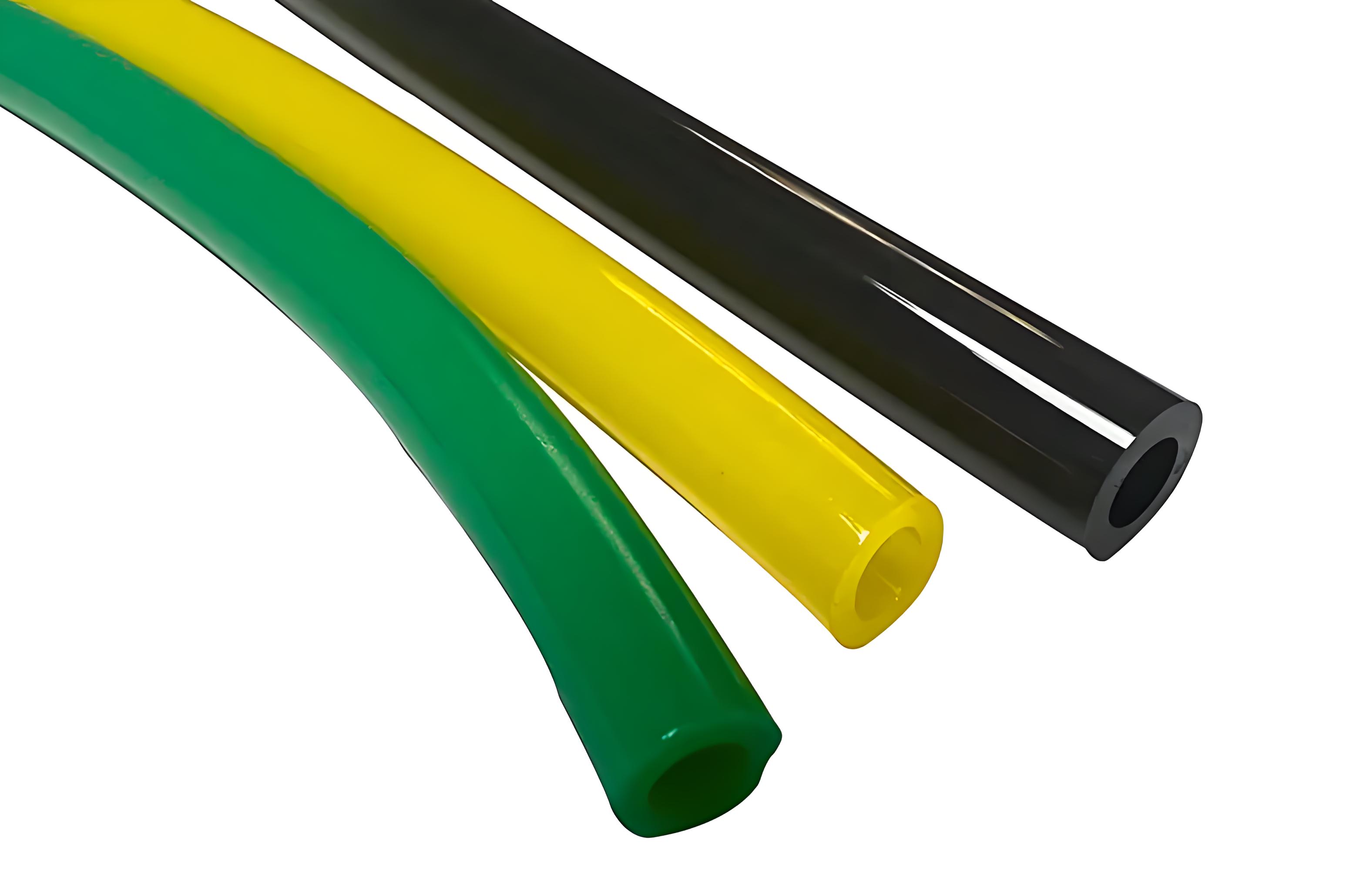
When selecting tubing for industrial, automotive, or pneumatic applications, chemical compatibility is often the difference between a decade of service and a catastrophic failure within weeks. Polyurethane (TPU) tubing has emerged as a versatile workhorse, but its performance is highly dependent on the specific chemical environment. Based on ASTM D543 testing protocols and real-world field data, here is a practical breakdown of how TPU performs against four critical chemical families.
1. Acids: Concentration is the Deciding Factor
The Data: In accelerated immersion tests (23°C, 7-day exposure), standard polyester-based TPU shows excellent resistance (weight change < 5%) to dilute acids like 10% hydrochloric acid and 10% sulfuric acid. However, when concentration exceeds 30%, the ester bonds in polyester TPU hydrolyze rapidly, leading to a 40-60% loss in tensile strength within 72 hours. Polyether-based TPU (like our Shanghai Xingen XG-PE series) significantly outperforms polyester variants, maintaining 80% elongation at break even after 14 days in 20% nitric acid.
Real-World Case: A chemical dosing system in a Taiwanese semiconductor fab switched from PVC to Xingen's polyether TPU for 15% sulfuric acid lines. After 18 months of continuous operation, the tubing showed only 0.8% swelling, whereas the previous PVC material cracked after 6 weeks.
Actionable Advice:
Always specify polyether TPU when handling mineral acids above 15% concentration.
For intermittent splashes of acid, even standard TPU works – but request a 24-hour soak test before committing.
Do not use TPU with glacial acetic acid or concentrated chromic acid (>50%). These will dissolve the polymer matrix within hours.
2. Solvents: Aliphatic vs. Aromatic – A Critical Divide
The Data: TPU exhibits outstanding resistance to aliphatic solvents like hexane, heptane, and white spirit. Volume swell after 30 days at room temperature is typically less than 3%. However, aromatic solvents (toluene, xylene, benzene) and chlorinated solvents (methylene chloride, perchloroethylene) are aggressive. MEK (methyl ethyl ketone) can induce 25-35% swelling within 24 hours, and THF (tetrahydrofuran) will completely dissolve TPU within minutes due to similar solubility parameters.
Industry Example: A paint spray equipment manufacturer in Germany used TPU hoses for solvent-based coatings. They experienced recurring hose blistering with xylene-containing thinners. Switching to our Xingen XG-HT series, which utilizes a highly crosslinked polycaprolactone backbone, reduced solvent uptake from 28% to 4.5% in xylene at 40°C.
Actionable Advice:
Never expose TPU to ketones, esters, or chlorinated solvents in continuous service. Even short-term cleaning cycles can cause micro-crazing.
For paint and ink transfer, verify the solvent's aniline point – a lower aniline point (<40°C) means greater swelling potential.
When in doubt, perform a "fingerprint test": apply the solvent to a sample for 15 minutes. If the TPU becomes tacky or whitens, it is incompatible.
3. Oils & Lubricants: The Sweet Spot for TPU Performance
The Data: This is where TPU shines. ASTM D471 testing shows that TPU retains 90-95% of its original tensile strength after 12 months of continuous immersion in mineral oils (ASTM Oil #1 and #3). Swelling is minimal – usually between 1-2% by volume. Even engine oils with detergent additives (which can attack some elastomers) cause less than 5% volume change over 6 months. For bio-based lubricants (vegetable oils, synthetic esters), polyether TPU shows slightly poorer resistance than polyester TPU, with up to 10% swelling, but still functional remains.
Field Data from Heavy Machinery: A leading excavator manufacturer in South Korea replaced nitrile rubber (NBR) return lines with Xingen TPU hoses in their hydraulic systems. After 5,000 hours of operation with ISO VG46 hydraulic oil at 80°C, the TPU hoses exhibited zero leaks and only 3% hardness change (Shore A 95 to 92). NBR had required replacement every 1,500 hours due to cracking.
Actionable Advice:
For fuel oils and mineral oils, standard ester-based TPU is your cost-effective choice. No need for premium polyether grades.
If operating temperatures exceed 90°C in oil environments, consider using our XG-HR series, which incorporates heat-stabilized additives.
Beware of certain phosphate ester hydraulic fluids (like Skydrol). These will swell TPU by 20-30%. For aviation hydraulics, use PTFE-lined TPU hose.
4. Fuels: Navigating the Ethanol & Biodiesel Complexity
The Data: The rise of oxygenated fuels has changed the game. TPU has excellent permeation resistance to pure gasoline (permeation rate < 0.5 g/m²/day per ASTM D814). However, ethanol-blended fuels (E10, E15, E85) are a different story. Ethanol causes TPU to swell by 15-20%, and more critically, it can extract low-molecular-weight plasticizers, leading to hardening and cracking. Biodiesel (B20 and above) has shown to be less aggressive than ethanol blends, causing ~8% swell but no significant degradation over 1,000 hours.
Critical Research Note: A 2019 study in Journal of Elastomers and Plastics compared ester and ether-based TPU in E85. Ester TPU lost 45% of its tear resistance after 6 weeks. Surprisingly, ether-based TPU performed worse, losing 55% – this is because ethanol molecules preferentially attack the ether linkages in the polymer backbone. Neither was suitable for flex-fuel lines.
Actionable Advice:
Never manufacture fuel lines from TPU alone for modern gasoline systems containing >10% ethanol. Use our co-extruded TPU/fluoropolymer composite tubing instead.
For short-duration fuel transfer (e.g., portable pumps, fuel sampling), TPU is acceptable, but you must replace the tubing every 6 months.
For diesel and biodiesel, TPU is safe – both standard grades work well. Spec a hardness of 95 Shore A to prevent kinking at high fuel pressures.
My Personal Take on Specification & Procurement
After nearly two decades in polymer engineering, I have seen too many engineers blindly choose TPU for its toughness, only to face a mess of swelling or cracking. The golden rules are: (1) Test under actual service conditions, not just at standard 23°C/50% RH; (2) Always define your chemical as a "mixture" – commercial solutions never contain just one chemical; (3) When in doubt, request documented immersion data from manufacturers like Shanghai Xingen. We provide free 14-day evaluation samples with your specific fluid to avoid costly trial-and-error in the field.
Final Word: TPU is an exceptional tubing material when deployed wisely. By matching the polymer type (ester vs. ether) to the chemical's functional group, you can unlock service lives exceeding 10 years in most oil and mild acid applications. For aggressive solvents and high-ethanol fuels, respect its limits – use alternative materials or reinforced composite constructions. Chemistry always wins; your job is to choose the right side.