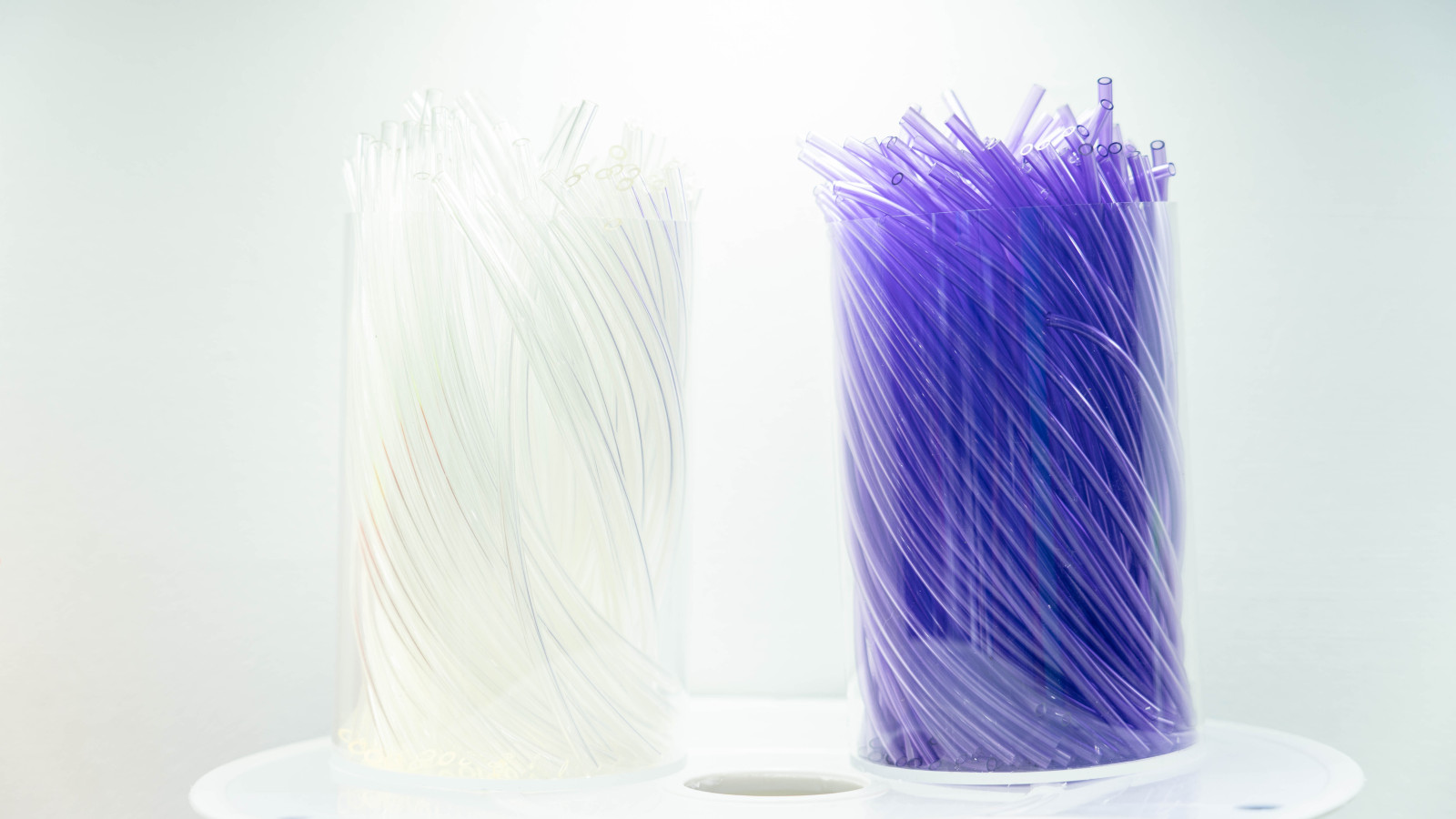
When selecting thermoplastic polyurethane (TPU) tubing for industrial, medical, or pneumatic applications, the choice between polyester-based and polyether-based variants is not merely a technical footnote—it's a decision that can dictate product lifespan, operational safety, and your bottom line. While both share the "TPU" label, their chemical backbones diverge dramatically under real-world stress. Let's break down the hard data, practical examples, and cost implications without the fluff.
1. Hydrolysis Resistance: The Silent Killer vs. The Survivor
Polyester TPU is inherently susceptible to hydrolysis—a chemical breakdown where water molecules attack the ester bonds in the polymer chain. This isn't a theoretical risk; it's a documented failure mode. For instance, a study by a major German elastomer manufacturer found that polyester TPU exposed to 80°C water (176°F) lost over 50% of its tensile strength within just 14 days. In contrast, polyether TPU under identical conditions retained more than 85% of its original strength after 60 days.
The mechanism is straightforward: ester groups are hydrophilic, meaning they attract water. Over time, the water catalyzes chain scission, leading to micro-cracking, loss of elasticity, and eventual catastrophic failure. This matters most in applications like hot-water hoses, underground cable jackets, or medical devices that undergo repeated autoclave sterilization.
Polyether TPU uses ether linkages (-C-O-C-) which are far less reactive with water. This makes it the undisputed champion for humid environments, marine applications, and any setting where the tubing cannot be kept perfectly dry.
Practical Advice:
If your tubing contacts water >40°C (104°F) periodically, choose polyether. Don't rely on "surface finishes" or additives to save a polyester product—they only delay the inevitable.
For beverage dispensing lines or washdown hoses, demand a polyether formulation and request accelerated hydrolysis test data (e.g., ASTM D3137) from your supplier before committing to bulk orders.
For dry pneumatic lines only, polyester can offer huge savings, but verify your compressed air system has a dryer to prevent condensation damage inside the tube wall.
2. Chemical Compatibility: Oil, Acid, and Solvent Warfare
Here's where the two families diverge most sharply. Polyester TPU is generally resistant to non-polar hydrocarbons like mineral oils and grease—which is why it dominates automotive fuel lines and hydraulic seals. However, its Achilles' heel appears when exposed to hot water, strong acids, or bases.
Polyether TPU, while slightly less robust against concentrated sulfuric or nitric acid, excels in resistance to fungal attack, dilute acids, and notably, polar solvents like ketones and alcohols. Moreover, polyether TPU has superior low-temperature flexibility. At -40°C, polyether TPU maintains an elongation at break of over 400%, while many polyester grades shatter or stiffen drastically.
Consider this industrial case: A food-processing plant used polyester TPU tubing for conveying a mildly acidic fruit concentrate. Within three months, the tube's inner wall blistered and peeled, contaminating product batches. Switching to a polyether TPU grade solved the issue permanently, extending service life to over 18 months despite continuous acidic flow.
Practical Advice:
Create a chemical compatibility chart for your specific media. Don't just look at the TPU "family"—check the hardness grade. A 95A Shore polyether will outperform a 70D polyester for acid splash.
Test at your actual operating temperature. Many chemical resistance charts are published at 23°C, which misleads engineers. A 20°C rise can double or quadruple the degradation rate.
If you see "environmental stress cracking" near fittings, revisit polymer selection. Polyether TPU often resists this better when the chemical is aqueous-based.
3. Cost Analysis: The Upfront Price Trap
Let's talk numbers. On average, polyether TPU raw material costs 20–30% more per kilogram than comparable polyester TPU. For a standard 6mm ID × 8mm OD tube, this translates to roughly $0.15 to $0.25 more per meter at the distributor level. In a 1,000-meter order, you might pay $150–250 extra upfront. That's the headline number salespeople throw at you.
But the total cost of ownership (TCO) tells a different story. In a 2022 analysis of hydraulic control lines in construction equipment, a fleet operator using polyester TPU reported a mean failure-free service life of 9 months. After switching to polyether TPU, the same lines lasted 28 months—a 211% improvement. The replacement cost per machine (parts + labor + downtime) was $340. Each machine required 2 polyester replacements per year vs. 0.43 polyether replacements. Annual cost per machine: Polyester = $680, Polyether = $146. Even after the higher initial material cost, the polyether solution saved over $500 per machine annually.
Practical Advice:
Run your own TCO calculation using your actual replacement frequency, not just material price per meter. Factor in downtime costs—these often dwarf material expenses by 10x–50x.
Negotiate volume pricing on polyether. Many manufacturers, including [Shanghai Xingen], offer tiered discounts at 5,000+ meters that can erase most of the cost gap.
Consider mixed usage: Use cheaper polyester for short, easily replaceable jumpers, but invest in polyether for permanent, hard-to-access runs.
4. Real-World Performance Data You Can Verify
Rather than relying on hearsay, ask any reputable TPU extruder for comparative data. For independent verification, look at datasheets from BASF Elastollan or Lubrizol Estane—they publish hydrolysis resistance curves.
Tensile strength retention after 3 weeks in 70°C water: Polyester TPU typically drops to 60% or below; polyether TPU stays above 90%.
Abrasion resistance: Surprisingly, polyester TPU often wins here. For pure rubbing contact (no water, no chemicals), a polyester grade can outlast polyether by 1.5–2x. This is why conveyor belts and sandblasting hoses use polyester.
Microbial growth: Polyether TPU does not support fungus growth, while polyester can serve as a carbon source. In medical or agricultural settings, this is non-negotiable.
My observation: The market has shifted. Silicone and PVC are being replaced by TPU in medical due to kink resistance. But engineers often default to polyester because it's cheaper, not because it's right. If you’re designing a product meant to last more than two years in any environment above 25°C with humidity, polyether TPU is the only rational engineering choice.
5. Practical Selection Checklist
Here is a condensed decision tree for your next project:
| Condition |
Recommended Grade |
Why |
| Dry air, protected indoors, low T |
Polyester TPU |
Cost savings, adequate strength |
| Water contact > 40°C, steam cleaning |
Polyether TPU |
Resist hydrolysis, maintain elasticity |
| Constant oil immersion, high pressure |
Polyester TPU (high hardness) |
Superior oil swell resistance |
| Acidic/basic aqueous solutions |
Polyether TPU |
Lower chemical degradation rate |
| Flex fatigue over hinges/moving parts |
Polyether TPU |
Better rebound and crack resistance |
| Extreme cold (-30°C to -50°C) |
Polyether TPU (plasticized-free) |
Retains flexibility, no brittleness |
The Bottom Line
There is no universal "best" TPU—only the most appropriate for your specific stressors. Polyester TPU remains a superb engineering material where water is absent and cost is paramount. But if you face moisture, broad chemical exposure, or need long term reliability, polyether TPU's premium upfront price is a bargain compared to repeated failures.
As a manufacturer, [Shanghai Xingen] provides both polyester and polyether TPU tubing, but our engineers don't push a "one-size-fits-all" solution. We recommend sending us your actual media composition, temperature range, and pressure specs. Based on years of testing data across medical and industrial sectors, we can match you to a polyether grade that will save you money over the product's lifecycle—even if the initial quote looks higher. Don't optimize for the purchase order; optimize for the asset's working life. Your machine—and your maintenance crew—will thank you.