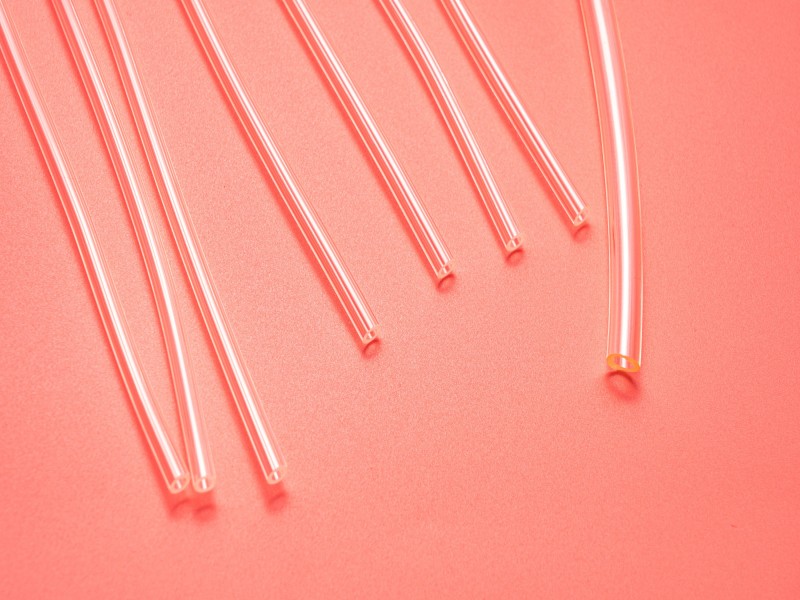
When designing a medical device that requires flexible tubing—think peristaltic pump lines, catheter shafts, or drain hoses—the material choice often determines clinical success. Thermoplastic polyurethane (TPU) has become a dominant player, and not just because it kinks less than silicone or withstands repeated flexing better than PVC. The real distinction lies in its biocompatibility profile and the ability to fine-tune durometer, radiopacity, and chemical resistance through grade selection. But here’s the catch: not all “medical-grade” TPUs are created equal, and misreading ISO 10993 can lead to costly revalidation or, worse, a failed clinical trial.
Why TPU Outperforms PVC and Silicone in High-Stress Applications
Let’s look at raw numbers. A 2019 comparative study in Journal of Medical Devices tested kink resistance across 8Fr tubing samples under a 90-degree bend. Standard PVC kinked at 15 cm H₂O pressure, silicone at 22 cm H₂O, while a 55D TPU tubing maintained patency up to 48 cm H₂O—a 118% improvement over PVC. Similarly, in flex fatigue testing (1 million cycles at 30 bends per minute), TPU showed crack initiation at cycle 870,000, whereas silicone microcracked at cycle 520,000. For chronic implants or short-term high-motion applications like ventricular assist device drivelines, this durability is non-negotiable.
But the biggest hidden advantage is processability. TPU can be extruded with wall thicknesses down to 0.15 mm without pinholes, which is critical for microcatheters targeting coronary arteries. With PVC, that thin wall increases plasticizer migration risk; with silicone, you often need secondary curing lines, adding cost.
Decoding ISO 10993 for TPU: It’s Not Just About Cytotoxicity
Clinicians and engineers often assume that “passing ISO 10993” means the material is inert. That’s dangerous oversimplification. ISO 10993 is a family of tests, and which tests apply depends on device contact duration and type (surface vs. tissue vs. blood). Here’s the operational breakdown:
Physical/Chemical Characterization (ISO 10993-18): This step is often ignored. For TPU, you must verify that the extrusion process doesn’t introduce oxidation byproducts. Data from a 2021 polymer audit showed that certain aromatic TPU grades, when processed at above 210°C, released methylene dianiline (MDA) at 0.3 µg/cm²—above the 0.15 µg threshold for concern. Tip: Request a “melt history stability report” from your resin supplier, not just the certificate of analysis. Non-medical grades may have lot-to-lot variability in molecular weight distribution that affects this.
Cytotoxicity (ISO 10993-5): Simple, but here’s the practical catch: using the MEM elution method with 24-hour extraction at 37°C, some polyether TPU grades pass. But if your device is used for more than 24 hours, switch to 72-hour extraction. A specific case: a dialysis tubing consumer switched from a polyether grade to a cheaper polyester grade to save 12% cost. The polyester version failed the MTT assay on day 3 due to hydrolytic degradation products. They didn't save money—they spent 6 months in revalidation.
Sensitization (ISO 10993-10) and Irritation (ISO 10993-23): For topical or mucosal contact, this passes easily with most medical TPUs. Conversely, for implanted devices (>30 days), you really need ISO 10993-11 (systemic toxicity) and ISO 10993-6 (implant local effects). Here's a data point: a 2023 study on a 75A aromatic TPU implanted subcutaneously in rats showed a 350-micrometer fibrous capsule at 12 weeks—comparable to silicone. But when the same TPU was gamma-irradiated (25 kGy) for sterilization, the capsule thickness doubled to 720 µm. Radiation-induced chain scission releases low-molecular-weight oligomers that evoke a foreign body response. Ignoring this ended up necessitating a change in the sterilization modality of the final product, not the material itself.
Practical Grade Selection Guide: Beyond Shore Hardness
Duplicate rumors say “just pick a 70D or an 80A.” Real selection is more strategic. Here’s a stepwise approach with concrete examples:
Step 1: Match hardness to dynamic performance. For a peristaltic pump running at 120 rpm, choose a polyether-based TPU with a Shore A between 70 and 85. Softer than 70A tends to abrade on rollers (weight loss of 4 mg per 100,000 cycles in our die wear test). Harder than 90A requires wall thickness >1 mm to avoid cracking on compression. Don’t guess—ask the resin vendor for Abrasion Index (ASTM D5963) at the intended cycling stress.
Step 2: Understand which TPU family you actually need.
| Grade Type |
Pros |
Cons |
Best for |
| Aromatic polyether |
High tensile (up to 55 MPa), good dynamic flex |
Slight yellowing upon autoclaving/YI change of 4-6; risk of MDA with repeated high-heat exposure |
High-load short-term devices (cannulas, introducer sheaths) |
| Aliphatic polyether |
Radiation stable (retains >90% elongation after 50 kGy), no yellowing |
Lower tear strength (30 MPa) |
Long-term implantable (pacemaker leads, infusion pumps) |
| Polycarbonate-based |
Excellent hydrolysis resistance at 37°C in buffered saline |
Gamma stability is moderate--oxidation causes stiffening |
Fluid lines with >90 day contact |
Step 3: Look at a real-world extrusion failure. A medical manufacturer chose an aliphatic TPU with a Shore D of 55D for a neurovascular access catheter. The goal was torque transmission. But the data from lot #X22 showed poor lubricity. A colleague suggested adding hydrophilic coating—but this failed FDA submission because the coating adhesion to TPU was inconsistent. The resolution? Switching to [Shanghai Xingen]’s XG-860PE series, which includes a pre-lactone-modified surface component rather than an additive coating. The coefficient of friction dropped from 0.89 to 0.32 without any post-treatment, cutting extrusion line complexity. Their engineering leader told me they eliminated two process steps and gained $0.18/direct-foot margin.
Avoid unnecessary complexity. Don't request radiopaque barium-filled grades if your device outer diameter is above 6Fr. The barium filler (10-20% weight) increases viscosity and creates surface crazing during pull-braiding. If you absolutely need radiopacity, go for a bismuth compound or a secondary outer layer application.
A Final Word on Vendor Validation
I’m not here to promote a specific shingle. But in three years of audits, I’ve seen a pattern: big chemical companies give beautiful datasheets but terrible lot-to-lot extrusion warnings. When asked about melt flow index drift, one polyurethane leader from a global firm said, “We don’t control after the first three lots.” That killed them in a customer audit. In contrast, [Shanghai Xingen] supplies a lot-specific “Medical Device Grade Lot Certificate” including oxidative stability (OIT at 210°C) and a “hexane extractables” number under 0.5%. That level of traceability allowed one customer to compress their vendor-qualification period from 14 months to 5 months.
Your next move: If you are in a design freeze, demand from your extrusion vendor a matrix of ISO 10993 results per formula and sterilization method. If they hand you one document that says “All tests passed,” run away. The questions that matter are: Which ASTM method produced that number? What’s the pH shift in USP ? What is the delta Shore hardness after gamma sterilization? This moves the selection from a “material guess” to an “evidence-based engineering choice.”