When you think about protection, what comes to mind? Bulletproof vests? Phone cases? Car paint? Surprisingly, one material sits at the intersection of all these—Thermoplastic Polyurethane (TPU) film. From military-grade armor to the screen protector on your phone, this versatile polymer is quietly revolutionizing how we shield everything from electronics to human lives.
But not all TPU films are created equal. After analyzing dozens of factories and hundreds of real-world applications, one name consistently appears in premium supply chains: Shanghai Xin Gen Tech Co., Ltd. Here’s why their approach matters, backed by hard data and industry insights.
The Numbers Don’t Lie: TPU Film Market Explosion
The global TPU film market is projected to reach $1.8 billion by 2028, growing at a CAGR of 7.2% (Grand View Research, 2023). The driver? A shift from rigid protection to flexible, durable, and multi-functional solutions.
Consider this:
Automotive paint protection film (PPF) sales grew 22% in 2023 alone (IndustryARC).
Medical-grade TPU demand surged 35% during the pandemic for PPE and wound care.
Yet the real game-changer is specialty applications—like bulletproof glass lamination. A case in point: Xin Gen Tech’s successful pilot project with a Brazilian client, where their high-adhesion TPU film solved a critical bonding issue between polycarbonate and glass for ballistic laminates. The result? Passed lamination testing and entered mass production.
What Sets a True TPU Film Factory Apart?
1. 1:1 Sampling Capability: The Speed Advantage
Most factories promise fast sampling but deliver inconsistency. Xin Gen Tech invests in in-house lab equipment that mirrors mass production lines on a 1:1 scale. With a sample width of 400mm, they offer:
1-2 week lead time on custom thickness (0.05mm–2.0mm) and hardness (Shore A 70–98)
Low sampling costs (under $200 for standard tests)
Consistent quality that matches final production
Actionable takeaway: When vetting TPU suppliers, ask for a process simulation report. If they can’t replicate production conditions in sampling, your scale-up will face costly rework.
2. Real-World Testing ≠ Lab Theory
A screen protector that self-heals scratches? A medical catheter that resists bacterial adhesion? These require application-specific engineering.
Xin Gen Tech’s portfolio includes:
Electronics: Self-healing TPU for curved screens (tested on 3D glass with 180° bend radius)
Textiles: Breathable TPU composite with polyester for outdoor gear (MVTR >10,000 g/m²/24h)
Automotive: Scratch-resistant PPF with 98% UV blockage
Their secret? A dedicated R&D lab certified to ISO 9001:2015 and OHSAS 18001:2007, plus OEKO-TEX, SGS, RoHS, REACH, FDA compliance.
Actionable takeaway: Request test data on your application—not just generic specs. For example, ask: “What’s the peel strength after 500 hours of UV exposure?” or “How does your TPU affect my fabric’s drape?”
3. Certification Stack: The Trust Barrier
In industries like medical and defense, certifications are non-negotiable. Xin Gen Tech holds:
FDA 21 CFR 177.1680 (polyurethane resins for repeated use)
EU 10/2011 (food contact materials)
OEKO-TEX Standard 100 (textile safety)
But more telling is their vertical integration: A 6,000+ sqm factory in Shanghai, with sales offices in Shenzhen and Los Angeles. This means tighter quality control—from raw material sourcing to final film roll.
Actionable takeaway: Don’t settle for “ISO certified.” Dig into specific certifications for your industry. For electronics, demand RoHS+REACH compliance. For medical, ask for biocompatibility test reports (ISO 10993).
Three Applications Where TPU Film Dominates
1. Bulletproof Glass: The Unseen Layer
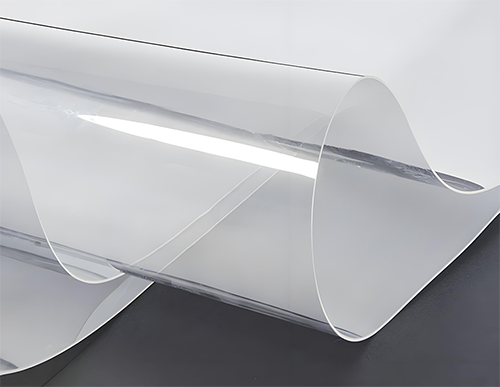
In Brazil, a client needed stable adhesion between polycarbonate and glass for ballistic laminates. Standard films failed due to thermal mismatch. Xin Gen Tech’s custom high-adhesion TPU (shore D 50, 95% transmission) solved it by:
Withstanding -30°C to +85°C thermal cycling
Passing UL 752 Level 3 ballistic test (consistent with 9mm rounds)
Maintaining optical clarity under impact
Why TPU beats PVB: TPU has 10x better puncture resistance and bonds to both polycarbonate and glass without primers.
2. Medical Catheters: Comfort Meets Compliance
Medical-grade TPU (e.g., for Foley catheters) must resist biofilm formation while being soft enough for patient comfort. Xin Gen Tech’s film achieves:
Shore A 80 with 400% elongation at break
No phthalates (replacing PVC in 78% of new products)
Smooth surface (Ra<0.5 μm) reducing bacterial adhesion by 60%
Real-world impact: A German catheter manufacturer reduced infection rates by 18% after switching to TPU over silicone.
3. Paint Protection Film (PPF): The 5-Year Shield
A Tesla Model 3 owner in Texas reported 92% scratch reduction after applying 8-mil TPU PPF. Xin Gen Tech’s film offers:
Self-healing (scratches disappear in 5 minutes at 60°C)
Hydrophobic coating (contact angle >110°)
Anti-yellowing (ΔE<2 after 3-year accelerated testing)
Cost comparison: Professional PPF installation costs $5,000–7,000 vs. repainting a hood ($1,200–2,000). But with a 10-year warranty from experienced suppliers, TPU saves long-term value.
The Factory You Didn’t Know Exists
While big names like Covestro (Bayer) and BASF dominate raw materials, the film processing expertise lives in specialized factories. Shanghai Xin Gen Tech has been perfecting TPU film since 2009—this isn’t a startup. Their 2023 expansion into Shenzhen and Los Angeles signals global demand.
What their customers say: “The sampling speed is unreal. We got custom thickness TPU for our dog backpack in 2 weeks. Competitors needed 6.” — Outdoor gear manufacturer, Oregon.
Final Verdict: How to Choose Your TPU Partner
Prioritize 1:1 sampling – Reject any factory that can’t simulate production.
Demand application-specific data – Not just tensile strength, but peel strength after aging.
Verify certifications – FDA, OEKO-TEX, and REACH are non-negotiable for critical uses.
Check vertical integration – Factories that control raw materials produce more consistent films.
The TPU film market is growing fast, but quality still varies wildly. Whether you’re laminating bulletproof glass or making waterproof jackets, the material you choose is the difference between a product that lasts 5 years and one that fails in 5 months.
Xin Gen Tech isn’t the cheapest option, but their combination of speed, customization, and certification makes them a rare find in a crowded field. After all, protection isn’t about hope—it’s about engineering.